




This blog runs on w_app_core, a Phoenix 1.8 / LiveView application: posts in Markdown and two languages, comments, likes, followers, friends, direct messages, groups, five locales. You are reading it in the browser, but the browser is no longer the only way in.
The JSON API
An administrator issues API tokens per user (Admin → API keys). A token is a bearer token, it acts exactly as its owner, and the same authorization rules apply as in the web UI. The API is deliberately small:
POST /api/postscreates a draftPOST /api/posts/:id/attachmentsuploads images, videos, PDFsPOST /api/posts/:id/publishpublishes it, optionally with"notify": trueto e-mail the followersGET /api/postsandGET /api/posts/:idlist and read your own postsPATCH /api/posts/:idupdates one
Draft first, publish second: when the notification goes out, the attachments
are already in place. Attachments are embedded in the body with {file.png},
optionally with a layout such as {file.png,right,40%}.
The clients
post-article (Bash, in the blog repository) is the reference client.
It turns a Markdown file with a small front-matter block into a post: subject
and body in English and German, tags, visibility, attachments, and on request
publish and notify. This article was posted with it.
iboard-tui is a full-screen terminal client: browse, search and filter
your posts, read them, publish drafts, create and edit new ones (through
post-article and your $EDITOR). The menu works like the command line of
the DOS-era word processors — Esc l i d lists the drafts, the bottom line
always tells you what can be typed next.
And because one language would have been boring, it exists in ten. All ports share keys, commands and config, and produce the same screen output, compared byte for byte in tmux:
| Port | Language | Lines |
|---|---|---|
bash/ |
Bash (the original) | ~1,900 |
perl/ |
Perl, core modules only | ~2,800 |
python/ |
Python, stdlib only | ~2,200 |
ruby/ |
Ruby, stdlib only | ~2,000 |
elixir/ |
Elixir (escript) | ~3,100 |
gleam/ |
Gleam (escript) | ~4,800 |
c/ |
C, libc | ~4,700 |
rust/ |
Rust, no crates | ~5,100 |
pascal/ |
Free Pascal | ~5,400 |
haskell/ |
Haskell, no Hackage | ~3,400 |
No third-party libraries anywhere; HTTP and TLS go through curl in every
port. Interesting side effect: putting the same program next to itself in ten
languages makes the differences between the languages very concrete. Bash is
the shortest, Pascal the longest, and Ruby is shorter than Elixir.
iboard-qt (version 0.2.2) is the desktop client, C++17 and Qt Quick on Qt 6.12, one binary. Same
API, same config, same keys and command palette, plus what a window does
better: list and post side by side, Markdown rendered with images, video and
audio players, attachments to download or save, a built-in editor with live
EN/DE preview, drag and drop for attachments, and the blog itself in a web
view. It follows the Omarchy theme, accent colour and light/dark mode.
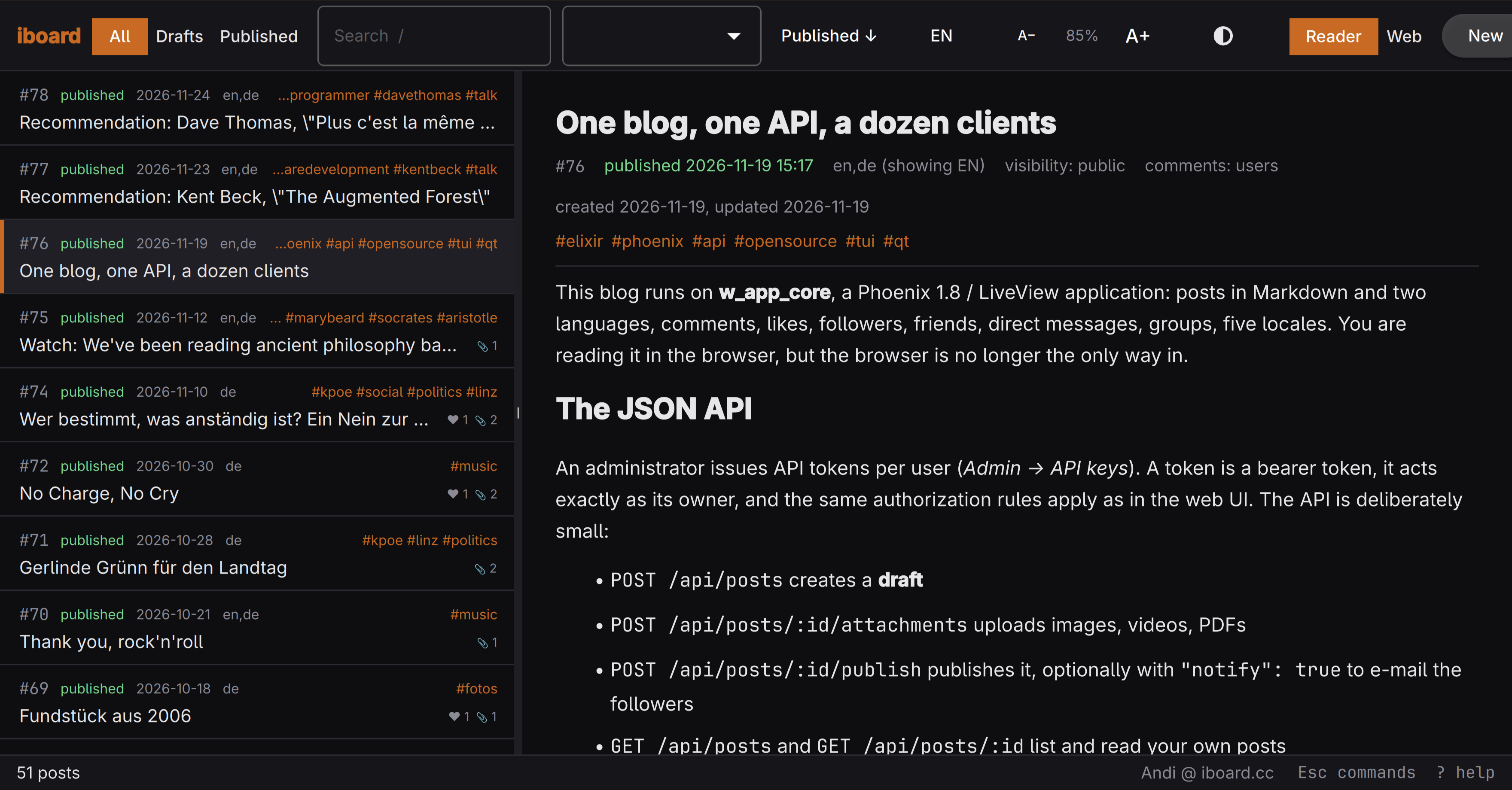
iboard-qt 0.2.2 on Omarchy: list and post side by side.
All clients share one config file, ~/.config/iboard-blog/config:
IBOARD_URL=https://iboard.cc
IBOARD_TOKEN=...
The repositories
- Blog (server, API,
post-article): https://github.com/iboard/blog - Terminal client, ten languages: https://github.com/iboard/iboard_tui
- Desktop client (Qt): https://github.com/iboard/iboard_qt
The repositories are still private. They will be published soon — until then the links lead to a 404. I will update this post when they are open.
Wanted
Linux is covered three times over. What is missing: an Android client, an
iOS client and a native macOS client. The API is documented in
API.md, it is about six endpoints, and the TUI shows what a client needs.
Anyone? ;-)